Travelling in Lithuania
Lithuania is the largest and southernmost of the Baltic states, a country where baroque church spires rise above forested hills and sand dunes stretch along an extraordinary spit of land reaching into the Baltic Sea. Its history as a medieval great power — the Grand Duchy of Lithuania once extended to the Black Sea — gives it a depth and complexity that surprises many first-time visitors.
Vilnius, Lithuania — a baroque capital
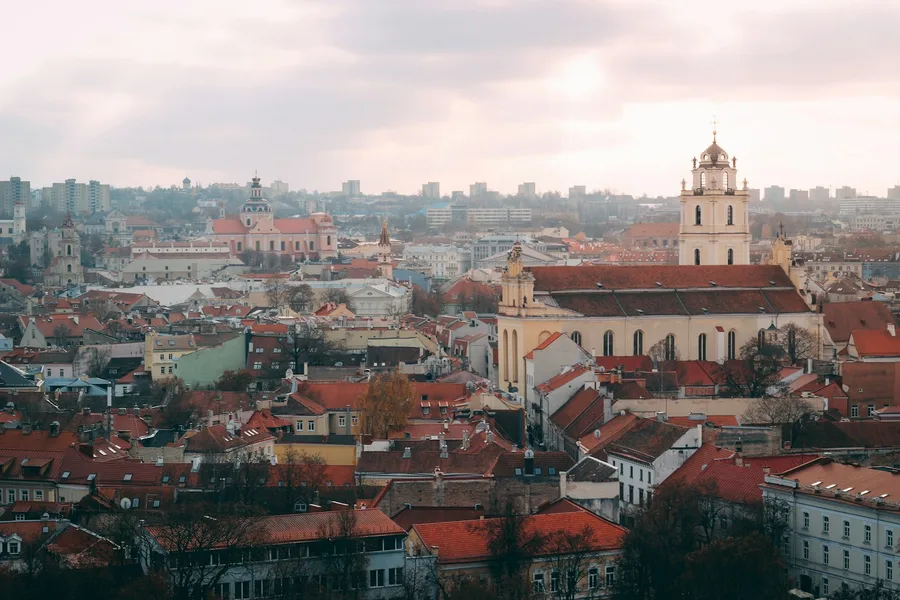
Vilnius Old Town is one of the largest surviving medieval and baroque ensembles in Europe, earning it UNESCO World Heritage status. The skyline is defined by church towers — over 50 of them, in styles ranging from Gothic to late baroque. Gediminas Tower, the remaining fragment of the Upper Castle, offers a panoramic view across the old town to the surrounding hills. Below it, the narrow streets reveal layers of history: the medieval Jewish quarter, the Gate of Dawn with its miracle-working icon, the university campus established in 1579.
Modern Vilnius has an edge, too. The Uzupis neighbourhood declared itself an independent republic (tongue firmly in cheek) and posted a constitution on a wall in multiple languages. The city's food scene draws on Lithuanian traditions — beetroot soup, cepelinai dumplings, smoked meats — and reinterprets them with contemporary technique. Hales Market, recently renovated, is a good place to sample local flavours.
Trakai and the lake district
Trakai Castle, Lithuania stands on an island in Lake Galve, about 30 kilometres west of Vilnius. The red-brick castle was the seat of the Grand Dukes of Lithuania in the 14th and 15th centuries, when the Lithuanian state was at its most powerful. Carefully restored in the 20th century, it now houses a museum of Lithuanian history. The surrounding town of Trakai is also home to the Karaim people, a Turkic community brought here by Grand Duke Vytautas in the 14th century, whose traditional kibinai pastries remain a local speciality.
The lake district around Trakai is part of a national park, with walking trails through forest and along lakeshores. In summer, the lakes are busy with kayakers and sailors. The landscape — gentle, green, dotted with wooden villages — feels a world away from the capital, despite being less than an hour's drive.
Kaunas — Lithuania's second city
Kaunas, Lithuania sits at the confluence of the Nemunas and Neris rivers, a strategic position that has shaped its history. The old town clusters around a 14th-century castle and a Gothic cathedral, but Kaunas is best known for its interwar architecture. When Vilnius was under Polish control between the wars, Kaunas served as Lithuania's temporary capital and embarked on an ambitious building programme. The result is a remarkable collection of modernist, art deco and functionalist buildings that earned Kaunas a UNESCO designation for its interwar architecture.
The city also has a strong museum culture. The MK Ciurlionis National Museum of Art honours Lithuania's most celebrated artist and composer, while the Devils' Museum houses a collection of over 3,000 devil figurines from around the world — a quirky counterpoint to the city's more serious institutions. Kaunas was named a European Capital of Culture and continues to develop its contemporary arts scene.
Northern Lithuania
The Hill of Crosses near Siauliai, Lithuania is one of the most striking sites in the Baltics. Over 200,000 crosses of every size and material cover a small hill — a tradition that began in the 19th century as an act of peaceful resistance against Russian rule. Soviet authorities bulldozed the hill at least three times, but the crosses always returned. Today it is a place of pilgrimage and contemplation, visited by Pope John Paul II in 1993. The sight of thousands of crosses catching the light on a quiet morning is not easily forgotten.
The coast — Klaipeda and the Curonian Spit
Klaipeda, Lithuania is the country's only port city and the gateway to the Curonian Spit. The old town has a distinctly Prussian character — half-timbered Fachwerk houses line the streets around Theatre Square, where a statue of the Romantic poet Simon Dach presides. The city has a lively cultural calendar, particularly during the Sea Festival in July.
From Klaipeda, a short ferry crossing takes you to the Curonian Spit, a UNESCO-listed sand dune peninsula that stretches 98 kilometres along the Baltic coast. The Lithuanian half of the spit is home to the fishing village of Nida, where Thomas Mann spent summers in the 1930s and where the Great Dune of Nida rises 52 metres above the lagoon. The landscape is extraordinary — shifting sand dunes, pine forests, wide beaches and a light that has attracted artists for over a century. In summer, the spit is popular but never crowded. In autumn and spring, you may have the beaches entirely to yourself.
Practical information
Lithuania uses the euro and is part of the Schengen Area. Vilnius has direct flights to most European capitals. The country is slightly larger than Belgium and easy to navigate by road — Vilnius to Kaunas takes about an hour, Vilnius to Klaipeda about three and a half hours. English is widely spoken in cities and tourist areas. Lithuanian is one of the oldest living Indo-European languages, and locals appreciate any effort to learn basic phrases — aciu (thank you) and labas (hello) will take you a long way.
The best months to visit are May through September, with June and July being the warmest. Lithuanian midsummer (Jonines) is celebrated on June 24 with bonfires, flower wreaths and folk singing. September offers warm days, fewer visitors and the beginning of mushroom season — a national pastime. Winter travellers will find atmospheric Christmas markets in Vilnius and Kaunas, and the chance to see the country under snow.
Places in Lithuania
Vilnius Old Town
One of Europe's largest baroque old towns with Gediminas Tower.
Trakai Castle
Red-brick island castle on Lake Galve.
Kaunas
Interwar modernist architecture and riverside castle.
Hill of Crosses
Pilgrimage site with over 200,000 crosses near Siauliai.
Klaipeda
Port city with Prussian old town, gateway to the Curonian Spit.
Curonian Spit
UNESCO-listed sand dune peninsula with Nida fishing village.
Journeys featuring Lithuania
Frequently asked questions
- Do I need a visa to visit Lithuania?
- Lithuania is part of the Schengen Area. Citizens of the EU, US, UK, Canada, and Australia can visit visa-free for up to 90 days. Check with a Lithuanian embassy for other nationalities.
- What currency does Lithuania use?
- Lithuania uses the euro. Card payments are accepted almost everywhere. Cash is only occasionally needed at small rural market stalls.
- What is the best time to visit Lithuania?
- June to August offers the best weather, with temperatures around 20–25 degrees and long daylight hours. September is excellent for fewer crowds and autumn colour. Vilnius has a well-regarded Christmas market from late November.
- How many days should I spend in Lithuania?
- Two to three days covers Vilnius and a day trip to Trakai. Five days allows for Kaunas, the Hill of Crosses, and either the Curonian Spit or Druskininkai. A week gives a thorough overview of the country.
- Is it easy to get from Lithuania to Latvia and Estonia?
- Yes. Direct buses run between Vilnius, Riga, and Tallinn daily, taking around 4–5 hours between each capital. Driving is straightforward on well-maintained roads. We can arrange private transfers between all three countries.