
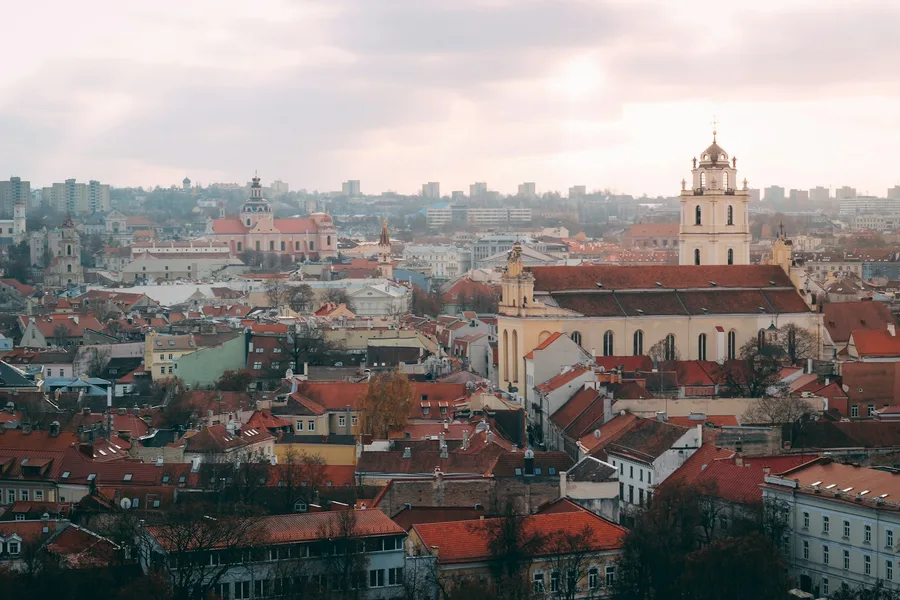
What to see in Vilnius in two days
Vilnius, Lithuania has the largest baroque Old Town in eastern Europe, a fact that sounds like a guidebook statistic until you walk through it. The scale is real -- you can spend two full days here without retracing your steps, moving from medieval churches to a self-declared independent republic to a hilltop with views over the whole city. Two days is enough to understand the shape of the place. Here is how to spend them.
Day one morning: Gediminas Tower and Cathedral Square
Start at Cathedral Square, the geographic and symbolic centre of Vilnius, Lithuania. The white neoclassical cathedral and its detached bell tower sit at the foot of Gediminas Hill. The cathedral was rebuilt in the late 18th century and looks more like a Greek temple than a church. Inside, the Chapel of St Casimir has baroque frescoes and a silver sarcophagus that survived both Soviet occupation and a fire.
Take the funicular or walk up to Gediminas Tower, the remaining piece of the Upper Castle. The brick tower dates from the 15th century and holds a small museum, but the reason to climb is the panorama. From the top you can see the red rooftops of the Old Town, the green hills beyond, and the river Neris curving through the city. On a clear day the view extends to the television tower on the southern edge of town.
The funicular runs from a station near the National Museum and takes about a minute. Walking up takes around 15 minutes via the steep path that switchbacks through the wooded hillside. The museum inside the tower is small -- two rooms covering the castle's history and archaeological finds from the hill -- but the terrace just outside the entrance is what most people come for. Arrive before 10am to have it largely to yourself. Entry to the tower and museum costs around 5 euros. The National Museum of Lithuania at the base of the hill is worth an hour if you want context on Lithuanian history from the Baltic tribal period through the Grand Duchy and into the 20th century.
Day one midday: into the baroque Old Town
Walk south from the cathedral into Pilies Street (Castle Street), the main artery of the Old Town. The street is lined with baroque and Renaissance facades, and it bends gently downhill past the university, small bookshops, and amber sellers. The university complex itself is worth entering -- it has a dozen interior courtyards, some dating to the 16th century, and the Church of St Johns with its baroque towers is part of the campus.
From Pilies Street, turn east toward the Church of St Anne. This small Gothic church, built around 1500, has one of the most intricate brick facades in the region. Napoleon reportedly wanted to carry it back to Paris. Beside it stands the Church of St Francis and St Bernard, a much larger building that frames the view from the other end of the square. The Bernardine Garden, recently restored, stretches behind these churches along the river -- a good place to sit for twenty minutes before moving on.
Continue south along Literatu Street, where the wall is covered in small artworks dedicated to writers connected to Vilnius. The pieces are unobtrusive and easy to miss if you are not looking. The street dead-ends near the Town Hall, which anchors a square that functions as the social centre of the old city.
The Vilnius University complex on Universiteto Street is one of the most architecturally varied campuses in the region -- founded by Jesuits in 1579, it encompasses a dozen courtyards in styles ranging from Gothic to Baroque to neoclassical. The central courtyard is open to the public, and the adjacent St Johns' Church has an interior that rewards close attention -- ornate Baroque altarpieces and a painted ceiling that dates from the late 17th century. The astronomical observatory in the east wing of the university is one of the oldest in northern Europe and still in use.
Day one afternoon: Hales Market and the Gate of Dawn
Walk south from the Town Hall to Hales Market (Haliu turgus), a covered market hall that sells fresh produce, smoked meats, cheese, bread, and prepared food. It is smaller than Riga's Central Market but more intimate. The food stalls inside serve Lithuanian dishes -- cepelinai (potato dumplings), saltibarsciai (cold beet soup in summer), and dark rye bread with curd. Lunch here will cost a few euros and will be better than most restaurants nearby.
From the market, walk to the Gate of Dawn (Ausros Vartai), the only surviving gate of the original city walls. Above the gate is a small chapel housing a painting of the Blessed Virgin Mary that has been venerated since the 17th century. The chapel is open to the public and feels remarkably quiet given that it sits directly above one of the busiest pedestrian passages in the city. The street leading to the gate -- Ausros Vartu Street -- is lined with churches and religious houses from several denominations, a reflection of the city's long history of coexistence.
Vilnius was for centuries one of the most religiously diverse cities in Europe -- home to Catholic, Orthodox, Protestant, Jewish, and Muslim communities, each leaving buildings that survive in varying states. The Church of St Theresa on Ausros Vartu Street, directly south of the Gate of Dawn, is one of the earliest Baroque buildings in Lithuania and has an interior of notable richness. The Basilian Gate and monastery complex behind it was used as a prison during the Soviet period and contains a small museum about the religious community's history. This section of the old city -- dense with religious buildings from half a dozen traditions -- is one of the most historically layered short walks in any Baltic capital.
Day two morning: Uzupis
Cross the Vilnele River into Uzupis, a neighbourhood that declared itself an independent republic in 1997 -- mostly as an art project, partly as a statement about community. The republic has its own constitution, posted on a wall in dozens of languages, and its own president. The constitution includes articles like "Everyone has the right to be happy" and "A cat is not obliged to love its owner, but must help in times of need."
Uzupis was, until the 1990s, one of the most neglected neighbourhoods in Vilnius, Lithuania. Artists moved in because rents were low, and the area gradually became a centre for galleries, studios, and small workshops. Today it is gentrifying, but the creative energy remains. The streets climb steeply from the river, and the houses are a mix of restored and crumbling -- painted in bright colours or bare plaster, often both on the same building.
The Uzupis Art Incubator and several small galleries are open during the day. The neighbourhood is small enough to walk in an hour, but interesting enough to linger in for a morning.
The constitution plaques are mounted on a wall along Paupio Street and printed in around 30 languages, including one in Morse code. Among the more memorable articles: "Everyone has the right to be unhappy" and "Everyone has the right to be idle." The angel statue at the centre of the main square -- a slender figure blowing a horn from the top of a column -- was installed in 2002 as a kind of civic mascot. The neighbourhood's main cafe strip along Uzupio Street has a handful of places for coffee and a late breakfast; prices are slightly lower here than in the Old Town proper. The art gallery at Uzupio 2 changes its programme regularly and tends toward the experimental.
Day two midday: Three Crosses Hill
From Uzupis or the Old Town, walk up to Three Crosses Hill (Triju Kryziu kalnas). Three white crosses stand on the hilltop, originally erected in the 17th century to commemorate Franciscan monks. The Soviet government destroyed the original crosses in 1950, and replacements were installed in 1989, just before independence. The climb takes about fifteen minutes and the path is well-marked.
The view from Three Crosses is arguably better than from Gediminas Tower -- you see the full spread of the Old Town below, with Gediminas Tower itself as part of the panorama. In the early morning or late afternoon the light is particularly good. Bring water; there is no shade at the top.
The path up from the Kalnai Park side is the most straightforward route and takes about 15 minutes. Near the top you pass through a section of the old city wall -- just a low fragment, but enough to mark the boundary of the medieval city. The crosses themselves are hollow concrete structures; the original wooden crosses that stood here were destroyed by the Soviet government in 1950, and the reconstruction in 1989 was one of the first open acts of civic defiance before independence. Coming down the other side of the hill brings you back into Uzupis, making it easy to combine both sites in a single morning loop.
Day two afternoon and evening: Bernardine Garden and rooftop bars
Spend the late afternoon in the Bernardine Garden, which was restored in 2013 and is now one of the pleasantest green spaces in the city. There are fountains, a small botanical collection, paths along the Vilnele River, and benches under old trees. It connects the Old Town to the river in a way that feels natural rather than designed.
For the evening, Vilnius, Lithuania has a growing number of rooftop bars and terraces. Several are on top of hotels in the Old Town and offer views over the churches and towers. The drinks are reasonably priced by European standards, and the atmosphere is relaxed. Look for places along Gedimino Prospektas or near the cathedral -- most open in May and close by the end of September, weather depending.
The rooftop terrace at the Artagonist Hotel on Literatu Street opens in the late afternoon and has good views toward the Old Town roofline. For dinner, Lokys (The Bear) on Stikliu Street is one of the oldest restaurants in Vilnius -- game-focused, atmospheric, and set in a 15th-century vaulted cellar. A three-course dinner costs around 30 to 45 euros per person. For something more contemporary, Sweet Root on Uzupio Street has become one of the most talked-about restaurants in Lithuania -- a tasting menu focused on foraged and fermented ingredients from around the country. Booking ahead is essential; the menu runs to around 60 euros per person.
Practical notes for Vilnius
The Old Town is compact and almost entirely walkable -- the main sights are never more than 20 minutes apart on foot. For Uzupis and the hills, the walks are short but steep in places. Taxis via Bolt are cheap; a ride across the city centre rarely exceeds 5 euros. The Vilnius Pass, available at the tourist information office on Vilniaus Street, covers entry to major museums and offers discounts at selected restaurants. It costs around 20 euros for 24 hours. Public transport is useful mainly for reaching destinations outside the Old Town -- trolleybus lines cover most of the city. A single trip ticket costs around 1 euro when purchased from a kiosk; day passes are available for around 3 euros.
Frequently asked questions
- How many days do you need in Vilnius?
- Two days covers the Old Town, Gediminas Tower, Uzupis, and the main museums well. Three days lets you add a day trip to Trakai Castle or explore the Vilnius street food scene more deeply.
- Is Vilnius worth visiting?
- Vilnius has the largest Baroque old town in Northern Europe, excellent and affordable food, a distinct bohemian character in Uzupis, and easy day trips to Trakai and Kernave. It is one of Europe's most underrated capitals.
- Is Vilnius safe?
- Vilnius is very safe for tourists. Petty crime rates are low, and most of the city centre is well-lit and comfortable to walk at night. Standard precautions are sufficient.
- What food should I try in Vilnius?
- Cepelinai (potato dumplings stuffed with meat), saltibarsciai (cold beet soup), kibinai (Karaite pastries from Trakai), and sakotis (tree cake). Hales Market is the best place to start.
Plan your visit
We organise private, guided journeys through the Baltics. Tell us your dates and we will build the route around you.
Start planning →