
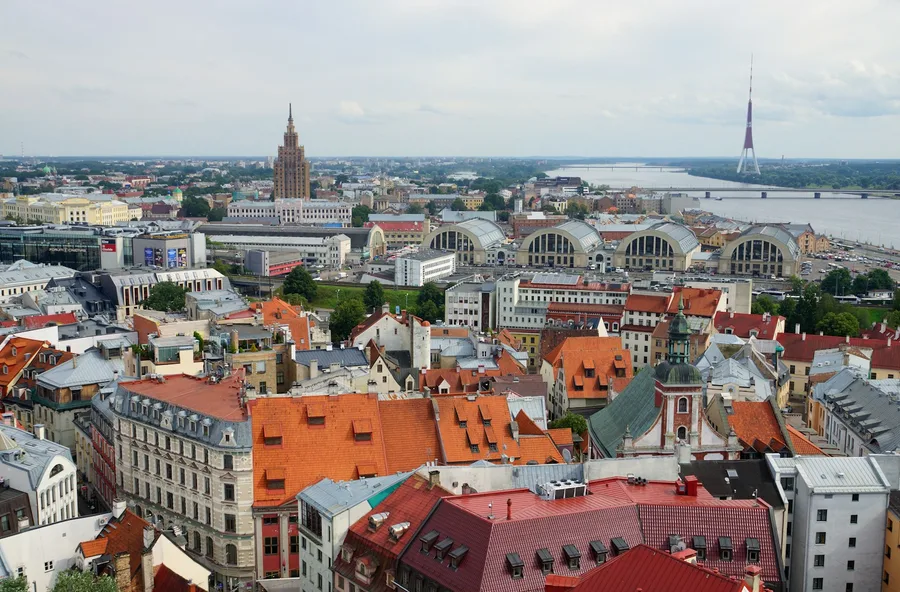
Things to do in Riga locals recommend
Most Riga guides will send you to the same five spots. This is not that list. These are the places we go ourselves -- the market stalls where we buy lunch, the streets we walk when friends visit, the bars we sit in on a Thursday evening. Riga, Latvia is a city that rewards wandering, and the things worth doing here tend to be quiet, unhurried, and a little off the obvious path.
1. Start the morning at Riga Central Market
The Central Market occupies five enormous Zeppelin hangars behind the train station. It is the largest market in Europe, and it has operated continuously since 1930. Each pavilion specialises -- meat, dairy, fish, vegetables, bread -- and the vendors are the same families who have run their stalls for decades. This is where Rigans actually shop.
Go to the fish pavilion first. Buy a piece of smoked mackerel or eel, a slice of dark rye bread, and eat it standing at one of the counters. The dairy pavilion sells curd cheese (biezpiens) and cottage cheese with herbs that you will not find this fresh anywhere else. Saturday mornings are busiest, but weekday mornings are calmer and the selection is just as good.
Behind the main hangars, the outdoor section extends along Negu iela and toward the canal. This is where seasonal produce piles up in late summer -- baskets of wild mushrooms, strings of dried flowers, honey sold from the back of vans by beekeepers from Vidzeme. The market also has a small street food row near the bus station end where you can get a bowl of soup or a Latvian pirags (baked pastry with bacon and onion) for under two euros. Give yourself at least an hour here.
2. Walk the length of Alberta Street
Alberta iela is a single residential block in the quiet centre of Riga, Latvia, and nearly every building on it is Art Nouveau. The architect Mikhail Eisenstein -- father of the filmmaker -- designed several of the facades, and they are genuinely extraordinary. Screaming faces, peacocks, sphinxes, and geometric patterns cover the upper storeys. The Riga Art Nouveau Museum at number 12 occupies a restored apartment and gives you a sense of what these buildings looked like inside around 1903.
The surrounding streets -- Elizabetes, Strelnieku, Vilandes -- are worth exploring too. This neighbourhood has the densest concentration of Art Nouveau architecture of any city in Europe, with more than 800 buildings in the style. Most visitors walk Alberta Street and leave. Spending an extra half hour on the side streets will show you facades that are just as interesting and entirely empty of tour groups.
Look for the deep blue building at Elizabetes iela 10b -- another Eisenstein design from 1903, with its rows of helmeted warrior heads and baroque cartouches. Around the corner on Strelnieku iela, the corner buildings offer long diagonal views of decorated facades. The Art Nouveau Museum entry costs around 6 euros and includes a tour of the restored apartment interior. The spiral staircase alone, with its original cast-iron railing and painted ceiling, is worth the fee.
3. Find the Quiet Centre neighbourhood
Just beyond the Art Nouveau district, between the parks and the canal, there is a residential area that Rigans call the Quiet Centre (Klusais centrs). The streets are lined with wooden houses and five-storey apartment buildings from the early 1900s, many with ornamental details. There are small cafes, a few galleries, and almost no tourists.
This is a neighbourhood for walking slowly. The pace here is noticeably different from Old Town -- people sit in courtyards, there are small gardens between buildings, and the streets feel lived-in rather than performed. It gives a more honest picture of daily life in Riga, Latvia than any museum district can.
The stretch between Dzirnavu iela and Brunieku iela is particularly good for wooden architecture -- two and three-storey timber buildings with carved window surrounds and pastel-painted facades that survived wartime and Soviet-era demolition largely by being overlooked. Small cafes and a wine bar on Krišjana Barona iela are neighbourhood spots that feel nothing like the tourist-facing Old Town. Prices are noticeably lower here too.
4. Cross the river to Kalnciema Quarter
Kalnciema iela, on the left bank of the Daugava, is a restored block of 19th-century wooden buildings that now houses a weekend farmers' market, a wine bar, a small gallery, and a few studios. The Saturday market runs from spring through autumn and draws a loyal local crowd. Vendors sell everything from smoked fish to handmade ceramics to seasonal fruit from Latvian farms.
The wooden architecture here is the real draw. Riga once had entire districts built of timber, and most of those buildings have been demolished or left to decay. Kalnciema is one of the few places where they have been carefully restored. Walk through the courtyard and you will see how these buildings were meant to look -- painted in soft colours, with carved window frames and courtyards shaded by old trees.
To reach Kalnciema from the Old Town, walk south along the Daugava embankment and cross either at the Stone Bridge (Akmens tilts) or the Railway Bridge. The walk takes about 20 minutes and gives you a view of the Old Town skyline from the opposite bank that most visitors never see. The neighbourhood around Kalnciema iela -- Agenskalns and Tornakalns -- has its own character, distinct from anything on the right bank. There are small bakeries, a neighbourhood market on Nicgales iela, and a relaxed tempo that makes this a good afternoon destination.
5. Sit for an organ concert at Riga Cathedral
The Riga Dom Cathedral, founded in 1211, holds one of the largest pipe organs in Europe. It was built in 1884 and has 6,718 pipes. Short organ concerts run several times a week -- usually around midday -- and last about 20 minutes. The acoustics in the cathedral are remarkable, and the sound fills the space in a way that recordings cannot replicate.
Even without the organ, the cathedral is worth entering. The cloister garden is one of the oldest enclosed spaces in the city, and the interior mixes Romanesque, Gothic, and Baroque elements from eight centuries of construction and rebuilding. Entry is a few euros. The concerts have a small additional fee.
The Dom Square outside the cathedral is the social anchor of the Old Town. In the mornings it is quiet enough to sit on the steps and watch the city move around you. By midday the cafe terraces fill up and the tour groups arrive. The Museum of the History of Riga and Navigation occupies the cloister buildings and is one of the better municipal museums in the Baltics -- the exhibition on Riga's Hanseatic trade era is particularly well done. Entry is about 7 euros.
6. Walk the old city walls and the Swedish Gate
Most of Riga's medieval fortifications were demolished in the 1850s, but fragments remain. The Swedish Gate, built in 1698, is the only surviving gate in the city walls. It opens onto Trokshnu iela (Noise Street), one of the narrowest lanes in Old Town. A short stretch of the original wall is visible along Tornu iela, where it was incorporated into later buildings.
Walking this section takes about fifteen minutes and connects several of the quieter parts of Old Town -- the Powder Tower, the Jacob's Barracks, and the old rampart mound near Bastejkalns park. It is a useful way to get away from the crowded centre while staying within the historic core.
The Powder Tower (Pulvertornis) at the northern end of the wall fragment is one of only two remaining towers from the original medieval fortifications. It houses a small military museum that gives useful context on the city's fortification history. The Jacob's Barracks next to the Swedish Gate are an unusual structure -- a long, low Baroque building from the 18th century that now contains a row of shops and cafes. The lane between the barracks and the wall is very narrow and easy to miss if you are not looking for it.
7. Sit in Vermanes Garden
Vermanes Garden is the oldest public park in Riga, Latvia, established in 1817. It sits between the Old Town and the Art Nouveau district and is a natural pause between the two. There is a small fountain, old linden trees, benches that fill up at lunchtime, and a flea market on weekends where people sell Soviet-era objects, old books, and coins.
The park is not spectacular -- it is simply a pleasant, ordinary place where Rigans go to sit. In summer, there are sometimes outdoor concerts. In autumn, the linden trees turn gold. It is the kind of place that makes a city feel like home rather than a destination.
The flea market runs on Saturdays and Sundays along the southern edge of the park, near Elizabetes iela. It is genuinely eclectic -- Soviet medals, amber jewellery, old Latvian postcards, handmade linen, pre-war ceramics, and piles of books in Latvian, Russian, and German. Prices are negotiable and the atmosphere is unhurried. It is one of those markets where you pick up something you did not know you were looking for.
8. Drink well in Old Town
Riga's Old Town has a growing number of small wine bars and craft beer spots that are worth seeking out. The craft beer scene in Latvia has grown quickly -- breweries like Labietis, Valmiermuiza, and Aldaris produce interesting seasonal beers, and several bars in the old town serve them on tap. For wine, look for the smaller bars on side streets rather than the ones facing the main squares.
The key is to avoid the ground-floor bars on Livu Square and Dome Square, which cater to stag weekends and charge accordingly. One street back, the prices drop and the quality rises. Ask for a Latvian beer and you will get something distinctive -- many local breweries use ingredients like birch sap, smoked malt, or bog myrtle.
Labietis, the craft brewery with a tap room on Aristida Briena iela in the Quiet Centre, is worth a detour if you are interested in unusual ingredients. They brew with yarrow, juniper, and seasonal foraged botanicals, and the tap room is a genuinely local place -- more music venue than tourist bar. In the Old Town itself, the wine bar Svela on Peldu iela has a good selection of natural wines from small producers and a calm atmosphere in the evenings. Craft beer from the Valmiermuiza brewery -- particularly their dark lager -- is available at most decent bars in the city and costs about 3 to 4 euros a pint.
9. Try Riga Black Balsam
Riga Black Balsam is a dark, bitter herbal liqueur that has been made in Riga, Latvia since 1752. It contains 24 ingredients -- roots, berries, bark, and botanicals -- and is sold in a distinctive ceramic bottle. It tastes medicinal in a good way, like something between Jagermeister and a strong amaro, but earthier and less sweet.
Most locals drink it with blackcurrant juice, which softens the bitterness. You can also try it warm with apple juice in winter, or simply neat as a digestif. The Black Balsam bar near the Dome Cathedral serves a full menu of cocktails built around the spirit. A small bottle makes a practical, inexpensive souvenir.
The Riga Black Balsam Cherry edition is noticeably smoother and sweeter, and a better introduction if the standard version puts you off. The ceramic bottle comes in two sizes: 0.5 litre and a smaller 0.2 litre that fits easily in a bag. The distillery also makes a Currant edition, which mixes well with tonic water. A standard 0.5 litre bottle costs around 8 to 10 euros at most supermarkets -- Rimi and Maxima both stock it near the checkout.
10. Look around the Central Station area
The blocks around Riga Central Station have changed considerably in recent years. New developments have brought cafes, co-working spaces, and restaurants to an area that was previously a transit zone. The station itself -- a Soviet-era concrete structure -- sits next to the market and the bus station, making it a natural crossroads.
This area gives you a sense of how Riga is evolving. The contrast between the market's Zeppelin hangars, the Soviet architecture, and the new glass-and-steel buildings is striking. It is not conventionally beautiful, but it is honest, and it tells you more about the city's trajectory than Old Town does.
The Origo shopping centre attached to the station brought a food hall and several restaurant chains to what was previously a dead zone. More interesting is the street-level development along Satekles iela and Marijas iela, where independent cafes and a few small restaurants have opened in the ground floors of older buildings. Rocket Bean Roastery on Miera iela -- about ten minutes' walk north -- is Riga's most serious specialty coffee operation, with a large roastery and cafe that draws a local crowd throughout the day.
11. Walk through Mezaparks
Mezaparks is a residential neighbourhood about 20 minutes by tram from the centre. It was built in the early 1900s as a garden suburb, and the streets are lined with wooden villas, pine trees, and quiet gardens. The neighbourhood borders a large park and the shores of Lake Kisezers.
There is no single attraction here -- the point is the atmosphere. Wide streets, birdsong, art nouveau wooden houses painted in faded colours, and very few people. The Song Festival grounds are here too, where the massive Latvian Song and Dance Festival takes place every five years. Even when empty, the open-air stage is impressive in its scale. Take tram number 11 from the centre.
The Mezaparks open-air concert stage can seat 30,000 people and was built specifically for the Latvian Song and Dance Festival, which has taken place every five years since 1873 -- a tradition listed by UNESCO. On a normal day the stage is empty, but walking up to the tiered stone seating and looking out at the pine trees gives some sense of the scale. The park around Lake Kisezers has a beach on the eastern shore where locals swim in summer. The walk from the tram stop along Kokneses prospekts through the villa district takes about 20 minutes and passes some of the best-preserved early-20th-century wooden architecture in Riga, Latvia.
12. Join a free walking tour
Several companies run free walking tours of Riga's Old Town and Art Nouveau district. The guides are usually young Latvians who know the city well and can answer the specific, unglamorous questions that guidebooks skip -- where to eat cheaply, which neighbourhoods are changing, what daily life is actually like.
These tours work on a tip basis. They tend to last about two hours and cover more ground than you would manage alone in the same time. They are a good way to orient yourself on your first morning in Riga, Latvia, before spending the rest of your visit following your own route through the city.
Free tours typically depart from the Town Hall Square (Ratslaukums) at 10am and noon in summer, with reduced schedules in winter. Riga Free Tour and Free Walking Tours Riga are the two most consistent operators. The Art Nouveau-specific tours are worth taking if architecture is your main interest -- the guides tend to have detailed knowledge of specific buildings and can point out details that are hard to find without guidance. A tip of 5 to 10 euros per person is the going rate for a good tour.
Where to eat beyond the tourist circuit
Riga, Latvia has a restaurant scene that has improved considerably in the last decade, but the best places are rarely on the main tourist squares. For traditional Latvian food in a genuine setting, Lido Recreation Centre on Krasta iela -- a large, canteen-style complex with a wood-fire oven and an indoor watermill -- is a Riga institution. It is enormous and slightly absurd, but the grey peas with bacon, dark rye bread, and smoked pork are authentic and cheap. A full meal with a beer costs around 10 to 14 euros.
For a more considered dinner, Restaurant Milda on Kalku iela takes Latvian ingredients and applies modern European technique -- pike-perch with fermented vegetables, venison with local berries, rye bread with cultured butter. A three-course dinner costs around 35 to 50 euros per person without wine. In the Old Town, Garage on Zigfrida Annas Meierovica bulvaris is a relaxed bistro with a good wine list and a menu that changes with the season.
Practical notes for getting around
The Old Town, Art Nouveau district, and Quiet Centre are all walkable from each other -- the distances are never more than 20 minutes on foot. Trams and trolleybuses cover the wider city well. A single ticket costs 1.50 euros when purchased from the driver; buying a card at a Narvesen kiosk and loading credit reduces the cost to around 0.90 euros per ride. Taxis via Bolt or Yango are cheap by European standards -- a ride across the city centre rarely exceeds 5 euros. Cycling is practical in the flat city centre: several operators have rental bikes available near the Old Town for around 8 to 15 euros per day.
Frequently asked questions
- How many days do you need in Riga?
- Two to three days is enough to see Riga's Old Town, Art Nouveau district, Central Market, and at least one neighbourhood beyond the centre. Add a day for a trip to Jurmala or the Gauja Valley.
- Is Riga worth visiting?
- Yes. Riga has the densest Art Nouveau architecture in Europe, a medieval Old Town, one of the largest covered markets on the continent, and a growing food scene. It is also significantly more affordable than western European capitals.
- Is Riga safe for tourists?
- Riga is very safe. Take normal urban precautions — watch for pickpockets in the Old Town and around the train station, and avoid poorly lit streets late at night. Violent crime against tourists is extremely rare.
- What is the best month to visit Riga?
- June to August for warm weather and long days. September for fewer crowds and autumn colour. December for the Christmas market in Dome Square.
Plan your visit
We organise private, guided journeys through the Baltics. Tell us your dates and we will build the route around you.
Start planning →