
Latvia, Lithuania, Estonia: all three?
People who have never visited the Baltics tend to group Estonia, Latvia, and Lithuania together as a single destination. People who know the region tend to have strong opinions about which country they prefer. Both instincts contain some truth. The three countries share a coastline, a complicated history, and a certain northern reserve, but they differ from each other in language, landscape, food, and temperament more than most outsiders expect.
Estonia: the Nordic one
Estonia looks north. Its language is Finno-Ugric, closely related to Finnish, and shares almost nothing with Latvian or Lithuanian. Tallinn's medieval Old Town is exceptionally well preserved — a walled Hanseatic port with cobbled lanes, merchant houses, and church spires that have barely changed since the 15th century. The country is small (1.3 million people), digitally advanced, and culturally closer to Scandinavia than to its southern neighbours. Outside Tallinn, the landscape is flat, forested, and dotted with bogs. The western islands — Saaremaa and Hiiumaa — are sparsely populated and quietly beautiful, with windmills, juniper pastures, and empty beaches.
Estonia suits travellers who value design, quiet nature, and a slightly reserved atmosphere. If you like Helsinki or Copenhagen, you will feel at home here.
Latvia: the middle ground
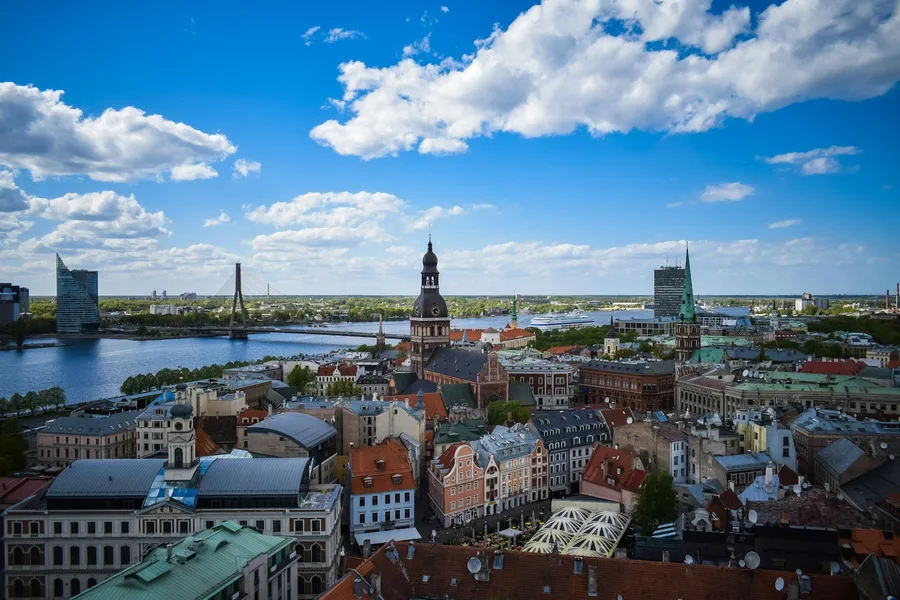
Latvia sits between its neighbours geographically and temperamentally. Riga is the largest city in the Baltics — roughly 600,000 people — and has a cosmopolitan, slightly gritty energy that Tallinn and Vilnius lack. The Art Nouveau district is world-class. The Central Market, housed in five enormous former Zeppelin hangars, is the best food market in the region. Outside the capital, Latvia offers the forested Gauja River valley (with medieval castles and sandstone caves), the long white beach at Jūrmala, and the quiet eastern region of Latgale, where Catholic churches and rolling hills feel more like rural Poland than the Baltic coast.
Latvia works well for travellers who want variety — urban culture, nature, and coastal relaxation within short driving distances.
Lithuania: the southern, Catholic one
Lithuania is the largest of the three by area and has a distinctly Central European feel. Vilnius has a baroque Old Town — one of the biggest in Europe — with a Catholic church on nearly every corner. The city is warmer in atmosphere than Tallinn or Riga, with a livelier cafe culture and a young, creative population that has filled formerly neglected neighbourhoods with galleries, studios, and restaurants. The Lithuanian language is Baltic (related to Latvian but not mutually intelligible) and is famously archaic, preserving features of Proto-Indo-European that other languages shed millennia ago.
Beyond Vilnius, Lithuania offers the Curonian Spit (a UNESCO-listed sand dune peninsula), the Hill of Crosses near Šiauliai, and Trakai — a red-brick island castle in a lake, thirty minutes from the capital.
Travel times between capitals
The distances are shorter than people assume. Vilnius to Riga is about 300 kilometres — roughly four hours by car or bus. Riga to Tallinn is 310 kilometres, also about four hours. Vilnius to Tallinn, the full north-south run, takes eight to nine hours by road, or you can fly in about an hour. The Riga-Tallinn and Vilnius-Riga bus routes run frequently and are comfortable. Rail Baltica, the high-speed rail line connecting all three capitals, is expected to reduce these times significantly once completed.
One country or all three?
If you have four or five days, choose one country and explore it properly. A week is enough for two. Ten days to two weeks is ideal for all three, especially if you want to include smaller towns and natural areas outside the capitals.
The most popular combination is Vilnius to Tallinn (or the reverse), with two or three nights in each capital and two nights in Riga between them. This works, but it can feel rushed if you want more than city highlights. A better approach for many travellers is to pair two countries and add a few days in the countryside — Riga plus the Gauja Valley and a night on the Curonian Spit, for example, or Tallinn plus Saaremaa island and a stop in Pärnu.
The mistake most first-time visitors make is treating the Baltics as a single destination with three interchangeable capitals. The capitals are different enough that the real question is not "which one" but "what kind of trip do I want."
For architecture and food: Riga, Latvia. For medieval atmosphere and digital culture: Tallinn, Estonia. For baroque beauty and a lively, walkable city: Vilnius, Lithuania. For nature: any of them, but each in its own way. The answer to "do you need all three" is usually yes — but not necessarily on the same trip.
Plan your visit
We organise private, guided journeys through the Baltics. Tell us your dates and we will build the route around you.
Start planning →