
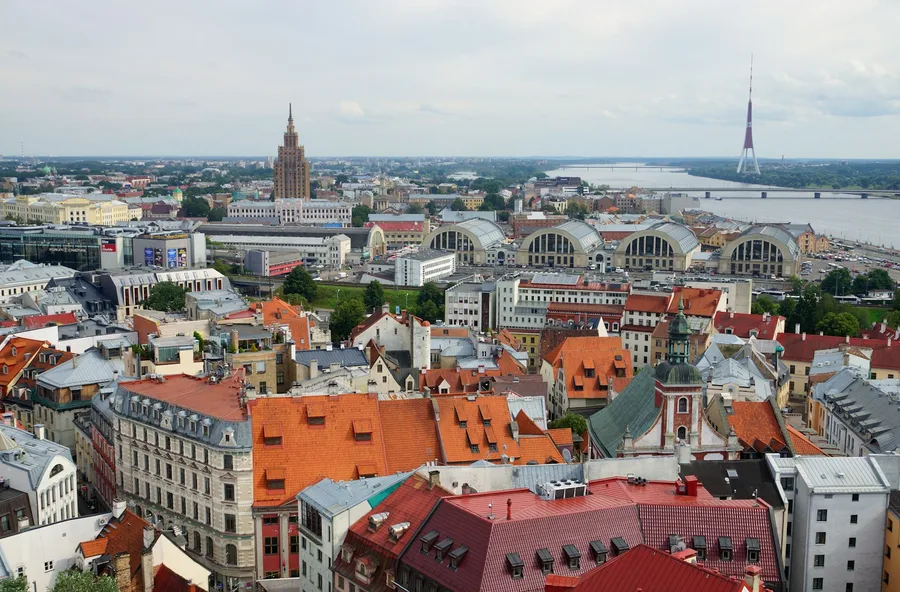
Riga's Art Nouveau district, Latvia
Most visitors to Riga hear that the city has Art Nouveau buildings. What they rarely grasp, until they walk through the quiet residential blocks north of the Old Town, is the sheer density of it. Over 800 buildings in the Jugendstil style survive here — roughly a third of all structures in the city centre. No other European capital comes close. Not Brussels, not Vienna, not Prague. The reason is simple timing: Riga was booming at exactly the right moment.
Why Riga, of all places
In the late 19th century, Riga was the Russian Empire's third-largest port and one of its fastest-growing cities. The medieval walls came down in the 1850s, and a ring of parks replaced the old moat. By 1900 the population had tripled in forty years, and the city needed housing — fast. The building boom of 1901 to 1914 coincided almost perfectly with the peak of Art Nouveau across Europe. Architects trained in Riga, St Petersburg, and Berlin applied the new style to entire blocks of apartment buildings, not just one-off commissions. The result is a neighbourhood where nearly every building on certain streets belongs to the same era and aesthetic.
The architects who shaped Riga's Art Nouveau quarter were responding to influences from Vienna, Berlin, and Helsinki, adapting the European Jugendstil tradition to local conditions — the Baltic northern light, the tastes of a cosmopolitan merchant class, and the particular mix of German, Latvian, Russian, and Jewish cultures that made Riga one of the most diverse cities in the empire. Several of the leading architects — Konstantins Peksens, Eizens Laube, Heinrich Scheel — were Latvians who had trained in Riga and St Petersburg. Their buildings differ from Eisenstein's grander productions in ways that are worth learning to distinguish. Eisenstein was a showman; his Latvian contemporaries were more restrained, drawing on folk motifs and a quieter sense of ornament.
Alberta iela: the essential street
Alberta Street is short — barely 300 metres — but it contains some of the most elaborate facades in northern Europe. The architect Mikhail Eisenstein (father of the filmmaker Sergei) designed several buildings here between 1903 and 1906. His style is unmistakable: monumental faces stare down from upper storeys, flanked by screaming masks, peacocks, and intertwined organic forms. Number 2a has the famous row of blue-faced figures and a pair of sphinxes at the entrance. Number 4 is topped with a colossal head surrounded by swirling plant motifs. Number 13, across the street, is perhaps the most theatrical of all — its entire facade seems to ripple with mythological figures.
Eisenstein's buildings tend toward what historians call "eclectic" or "decorative" Art Nouveau. They are designed to overwhelm. Stand on the opposite pavement and look up — these facades were meant to be read vertically, storey by storey, like a column in stone.
Alberta iela 2a and 4 are Eisenstein's most photographed buildings and can be examined in ten minutes, but the full sequence rewards a slower pace. Number 6 was designed by a different architect, Mikhail Eisenstein's peer Friedrich Scheffel, and offers a useful comparison — it is elegant where Eisenstein's buildings are operatic. Number 8, by another hand, shows how the same Jugendstil vocabulary could produce something more restrained and residential. Walking the entire street twice — once on each side — takes about 20 minutes and gives you the facades in proper order. Morning light is flat; late afternoon turns the facades amber.
Beyond Alberta: Elizabetes and Strēlnieku
The district extends well beyond one street. Elizabetes iela, a wider boulevard running parallel, has its own remarkable facades, including the deep blue building at number 10b, designed by Eisenstein in 1903, with its symmetrical rows of helmeted heads. Strēlnieku iela connects the two and offers a quieter walk with excellent perpendicular views of decorated corner buildings.
Further east, around Brīvības iela and Tērbatas iela, the style shifts. Here you find "National Romantic" Art Nouveau — buildings by Konstantīns Pēkšēns and Eižens Laube that draw on Latvian folk art rather than Viennese ornament. The facades are plainer but richer in local symbolism: stylised suns, oak leaves, and geometric patterns drawn from traditional textiles. These buildings feel distinctly Latvian in a way that Eisenstein's cosmopolitan fantasies do not.
The building at Terbatas iela 15-17, designed by Peksens, is one of the best examples of the National Romantic approach: the facade carries carved oak branches, geometric borders derived from traditional woven textiles, and a central gable shaped like a Latvian folk ornament. It would be nondescript by the standards of Alberta Street, but on its own terms it is quietly remarkable. The contrast between Eisenstein's screaming faces and Peksens's oak branches tells you something real about the two strands of Latvian cultural life at the turn of the century: one cosmopolitan and empire-facing, one rooted in an emerging national identity. Both were expressed simultaneously in the same neighbourhood of Riga, Latvia, in the same decade.
The Art Nouveau Museum
At Alberta iela 12, a restored apartment from 1903 has been preserved as the Riga Art Nouveau Museum. The interior is as important as the facade here. The original spiral staircase, painted ceilings, tiled stoves, and period furniture give a sense of how these buildings were actually lived in. The apartment belonged to Konstantīns Pēkšēns, who designed the building himself. It is small — two or three rooms open to visitors — but it is the only place in the district where you can step inside the era rather than admiring it from the street.
The museum entry costs around 6 euros and usually includes a short guided commentary from a staff member, though you can also explore at your own pace. The rooms are furnished with period pieces — heavy dark wood furniture, porcelain figurines, framed photographs of the building's original occupants — and the contrast between the domestic scale of the interior and the theatrical excess of the facade is striking. The tiled stove in the main room is original and still intact; these were the primary heating source in such apartments and were made to be decorative as well as functional. The museum gift shop sells a well-produced guide to the Art Nouveau district that is more useful than the free maps. Allow about 45 minutes for a thorough visit.
A walking route that works
Start at the corner of Strēlnieku iela and Alberta iela. Walk the full length of Alberta slowly, staying on the odd-numbered side first, then crossing back. Turn right onto Elizabetes iela and walk south toward the park. At Vīlandes iela, cut east one block to see the National Romantic buildings around Tērbatas iela. The entire walk takes about 90 minutes at a comfortable pace, longer if you stop at the museum.
Late afternoon light is best for Alberta Street — the facades face roughly west and glow in low sun. Mornings are quieter, but the buildings sit in shadow. In winter, fresh snow on the ornamental ledges picks out details you might otherwise miss.
For a longer walk, extend the route north along Antonijas iela and then west along Kristapa iela toward the Viestura Garden. This takes you through a quieter section of the Art Nouveau district where the buildings are less photographed and the streets are residential rather than touristic. Viestura Garden itself is a small park at the northern edge of the district, useful for a rest before doubling back. The full extended route runs to about two and a half hours. A guided tour of the district — available through several Riga tour operators and through the Art Nouveau Museum itself -- typically runs 90 minutes to two hours and covers about a dozen buildings in depth. The entry-level tours cost around 15 to 20 euros per person.
The best way to see the district is to forget the map for a while. Walk the side streets. The facades that surprise you most will be the ones nobody mentioned.
Riga's Art Nouveau quarter is not a museum district or a reconstruction. These are working apartment buildings where people live, hang laundry on interior balconies, and park bicycles in tiled entryways that would stop you in your tracks in any other city. That ordinariness is part of what makes the neighbourhood so remarkable — an entire chapter of European architecture, still in daily use, still mostly overlooked.
What to know before you go
The Art Nouveau district is about a 15-minute walk north of Riga's Old Town, or a short tram or trolleybus ride from the city centre. The closest stop is on Elizabetes iela; several tram lines stop nearby. The district is entirely outdoors and free to explore — the only paid entry is the Art Nouveau Museum at Alberta iela 12, which charges around 6 euros. The museum is open daily except Mondays, generally from 10am to 6pm, though hours vary by season.
Most of the facades are best seen from the street. Do not enter the building lobbies without permission, but note that many have their main doors open during the day. The tiled entrance halls and stairwells of these buildings are often as interesting as the facades; the ones that are accessible reward a quick look. Photography from the street is unrestricted. The best single afternoon in the district: arrive at Alberta iela around 3pm, walk the street twice, visit the museum, continue along Elizabetes iela and Strelnieku iela before the light fades, then stop for coffee or a glass of wine at one of the small cafes on Bruninieku iela or Dzirnavu iela nearby.
Art Nouveau and the question of survival
It is worth asking why Riga's Art Nouveau district survived at all. The answer is complicated. The German occupation of World War One damaged some buildings; the Soviet period nationalised them all and converted them to communal housing, which paradoxically meant they were maintained at a basic level rather than demolished for new construction. Post-war Soviet planners did tear down some Art Nouveau buildings on the fringes of the district, but the core blocks were largely left intact because they were in use.
After independence in 1991, the buildings were privatised and returned to something closer to their original function as apartment buildings. The restoration process has been uneven — some facades have been carefully repaired, others are still in the peeling, weathered state they fell into during the Soviet period. This unevenness is not entirely unwelcome: a district where everything has been freshly painted and restored loses the quality of being genuinely inhabited over time. The mixture of restored and unrenovated buildings in Riga, Latvia gives the district a lived-in quality that heritage zones often sacrifice in pursuit of visual consistency.
The Riga City Council has listed most of the significant buildings and requires owners to obtain permits for changes to facades, but enforcement is imperfect and funding for restoration is limited. Several of the most significant Eisenstein buildings on Alberta iela have been restored with EU cultural heritage funds. Others are maintained by their current owners at varying levels of care. Walking through the district with some knowledge of this history makes it more interesting — you are looking not just at architecture but at the question of what a city chooses to preserve and why.
Beyond the district: Art Nouveau across Riga
The concentration of Art Nouveau buildings in the district north of the Old Town is the most famous, but the style is distributed across the whole inner city of Riga, Latvia. The boulevard ring that replaced the old city walls in the 1850s created a band of prestige addresses where wealthy developers and civic institutions commissioned Art Nouveau buildings well into the 1910s. Kronvalda Boulevard, running parallel to the canal, has several notable examples that are often missed by visitors focused on Alberta iela.
On Ģertrūdes iela, further north, a stretch of apartment buildings includes some of the best-preserved National Romantic facades outside the main district. The Latvian National Theatre on Kronvalda Boulevard is an Art Nouveau building in its own right, with a facade that combines classical columns with organic Jugendstil ornament in a way that is typical of the transitional style common in Riga around 1902. The Latvian Society House on Merkela iela is another significant building — the cultural centre of the Latvian national movement at the turn of the century, designed in a sober version of the national romantic style.
For a visitor with more than a day to spend on architecture, the full picture of Art Nouveau in Riga, Latvia extends well beyond Alberta Street and into the fabric of the whole 19th-century city. The best way to approach it is to treat the Alberta iela district as an introduction and then follow the style wherever it appears as you walk through the city — which, in the inner ring of Riga, Latvia, will be almost everywhere.
Plan your visit
We organise private, guided journeys through the Baltics. Tell us your dates and we will build the route around you.
Start planning →