
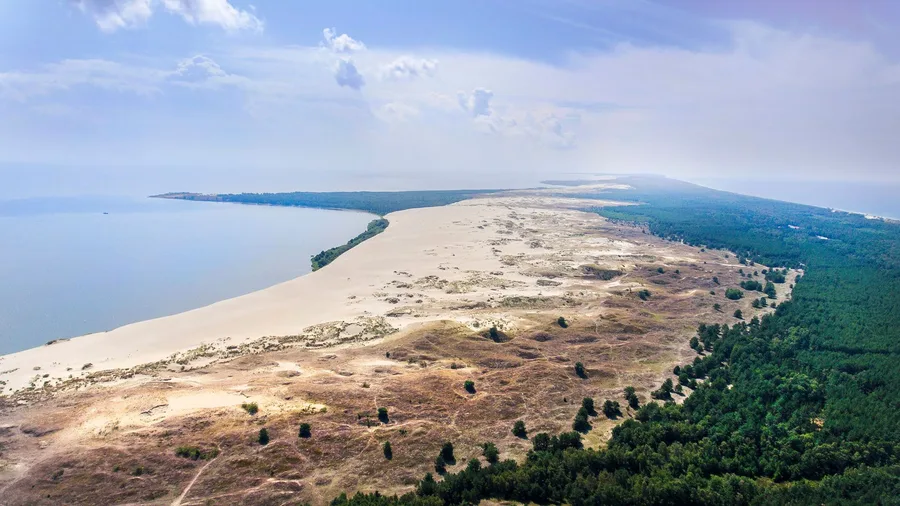
The Curonian Spit dunes, Lithuania
The Curonian Spit is a 98-kilometre ribbon of sand stretching from Klaipėda, Lithuania, south to Kaliningrad, Russia. At its narrowest it is barely 400 metres wide. On one side lies the Curonian Lagoon, shallow and still; on the other, the open Baltic Sea. UNESCO inscribed the spit in 2000, calling it "an outstanding example of a landscape of sand dunes under constant threat from natural forces." That phrasing gets at the strange quality of the place — it feels provisional, as if the wind might rearrange everything overnight.
Parnidis dune and the scale of sand
The centrepiece of the Lithuanian half is the Parnidis dune, just south of Nida. It rises 52 metres above the lagoon and offers views in every direction — pine forest, open water, the rooftops of Nida below, and the Russian border fence a short walk to the south. A granite sundial stands at the summit, installed in 1995 and partially toppled by a storm in 1999, then rebuilt. The dune itself is alive, shifting south and east by roughly a metre each year. Walking paths are marked and enforced; stepping off-trail accelerates erosion and can earn a fine.
What strikes most visitors is the silence. The dune is large enough that the wind drops in its lee, and the sand absorbs sound. Stand on the ridge at dusk and the lagoon below turns copper. It is a landscape that rewards patience more than movement.
Nida: the village that stayed
Nida is the main settlement on the Lithuanian side, a village of about 1,500 year-round residents that swells considerably in summer. The old fishing houses along the lagoon shore are painted in the traditional Curonian palette — dark brown timber with blue or white trim. The harbour still has a few working boats, though tourism has long overtaken fishing as the primary economy.
Thomas Mann spent the summers of 1930, 1931, and 1932 in a cottage on a bluff above the lagoon. He called the spit "the most remarkable landscape I've ever seen" and wrote much of the Joseph novels here. The house is now a small museum — a few rooms of photographs and manuscripts, with the real draw being the view from the terrace, which has not changed in ninety years. The lagoon stretches flat and grey to the east, and on clear days you can see the mainland shore of Lithuania.
Two sides of the spit
The lagoon side and the Baltic side feel like different worlds. The lagoon is warm, calm, and shallow — children wade out thirty metres and the water barely reaches their waist. Reeds grow along parts of the shore, and herons stand motionless at dawn. The Baltic side is cooler, rougher, and emptier. Wide beaches of pale sand face north and west, with the sea stretching unbroken toward Sweden. In autumn, storms push the surf high onto the beach, and the sand is littered with amber fragments — small, clouded pieces that locals collect in the morning before the tourists arrive.
Smoked fish and the food of the spit
Smoked fish is the signature of the Curonian Spit. Small smokehouses along the road between Nida and Juodkrantė sell bream, perch, and eel smoked over alder wood. The eel is the local delicacy — rich, oily, and slightly sweet. Buy it wrapped in paper and eat it on a bench by the lagoon with dark bread. In Nida's restaurants, the fish is often served with beetroot soup and boiled potatoes, a meal that has not changed much in a century.
When to go
July and August bring crowds and warm lagoon water, but also traffic on the single road that runs the length of the spit. June and September are better months — fewer visitors, milder light, and the pine forests full of birdsong. Late September and October are genuinely beautiful, with the birch trees turning gold against the dark conifers and the beaches almost entirely empty. Winter is austere and cold, but the dune in snow is an extraordinary sight, and the village restaurants stay open year-round.
The spit is not a day trip. Spend at least one night. The quality of the light changes completely between afternoon and morning, and the dune at sunrise is a different place than at midday.
Getting to the spit requires a short ferry crossing from Klaipėda — cars and passengers board at the Old Ferry Terminal, and the ride takes about five minutes. From Nida, it is roughly 50 kilometres south along the single road, with Juodkrantė (known for its Hill of Witches wood-sculpture trail) about halfway. The entire Lithuanian half can be explored by bicycle in a day, though most visitors prefer the slower pace of a two- or three-night stay.
Plan your visit
We organise private, guided journeys through the Baltics. Tell us your dates and we will build the route around you.
Start planning →